 Galveston Golf Cart Repair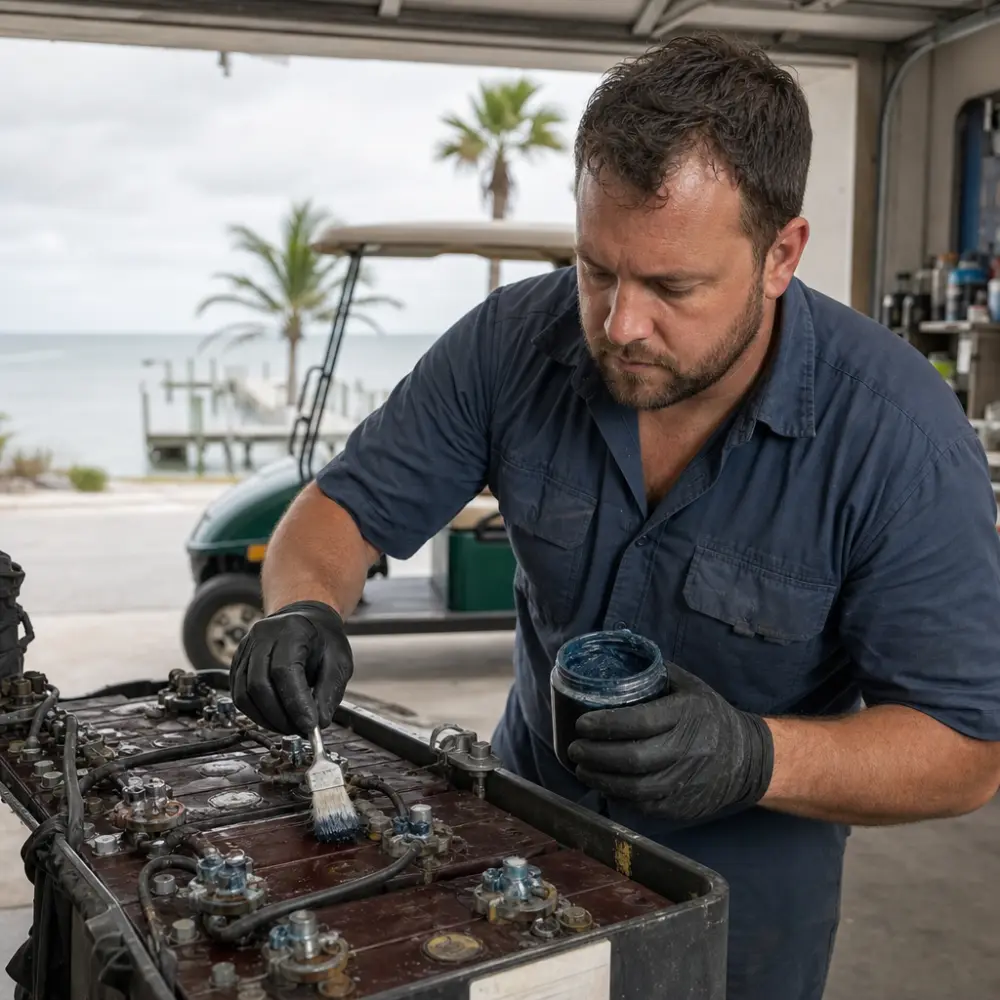
Galveston Golf Cart Repair sends a technician to your driveway, garage, cart barn, or fleet lot anywhere on Galveston Island and the surrounding Upper Texas Coast and fixes your cart on-site: batteries, brakes, tires, chargers, solenoids, motors, controllers, and lights. A full lead-acid battery pack runs $1,200 to $1,800 installed, brake work $75 to $400, tires $75 to $150 each, and the $50 to $100 service call is applied toward your repair. Describe the symptom by form and we usually arrive with the likely parts already on the truck.
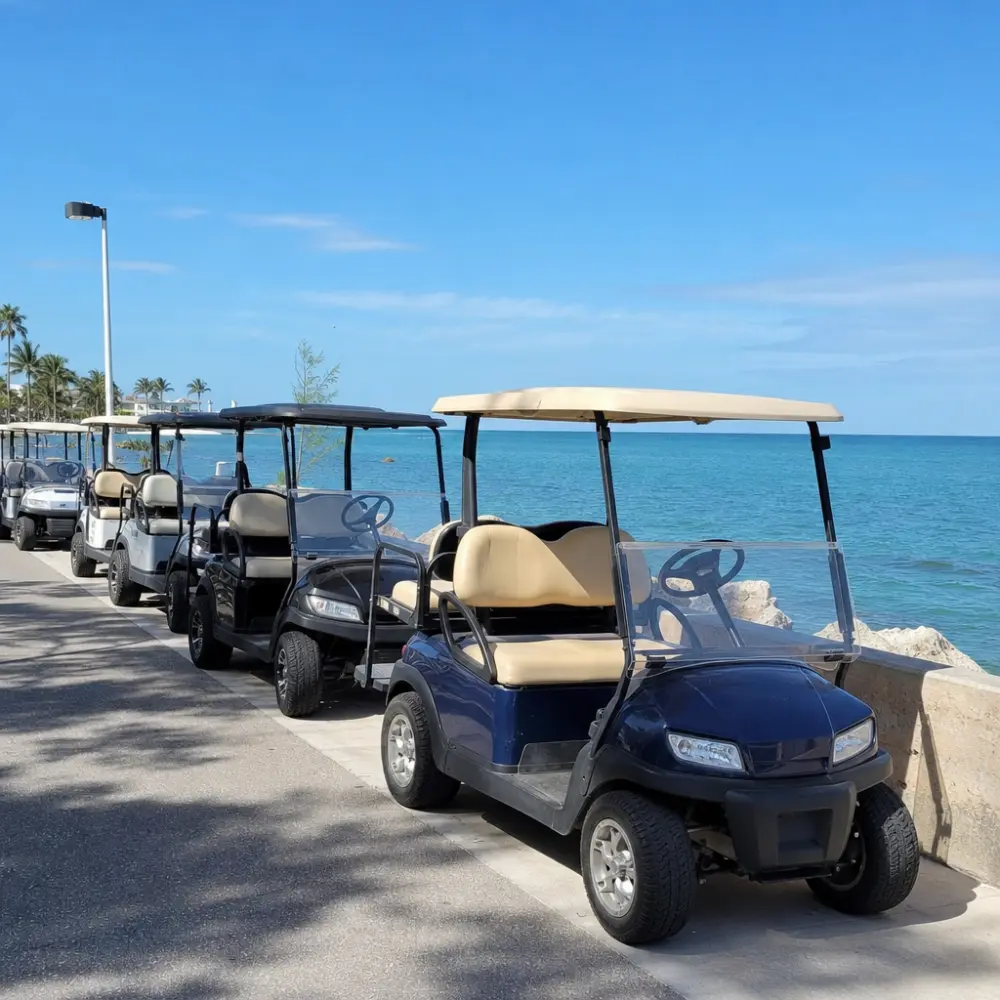
Galveston is a golf cart town for a reason no inland market shares: an island where the Strand, the Seawall, and the historic neighborhoods in between sit close enough together that a cart genuinely replaces a car for a lot of trips, a year-round population of 53,695 as of the 2020 Census, and a tourism economy that puts thousands of rental carts on the same streets every weekend. That mix is exactly why everything we do is mobile, and why the fixes that matter here (corroded terminals, a battery box that took saltwater, a rental fleet that needs six carts turned around by Friday) are different from what a golf-course suburb needs.
What we fix, at your home or your fleet
- Mobile golf cart repair: the core service. On-site diagnosis and repair of whatever is wrong: will not move, will not charge, weak coming back from the Seawall, clicking, cutting out. All major brands, electric and gas.
- Battery replacement: new lead-acid packs installed with haul-away of the old cores, plus honest lead-acid versus lithium math for carts that run seven days a week in tourist season.
- Brakes and tires: adjustments, shoes, drums, and new tires installed in your driveway. Sand off the beach and salt on the hardware both wear parts faster than the brochure assumes.
- Motor and controller repair: solenoids, speed controllers, and drive motors diagnosed with meters before anything gets replaced.
- Charger repair: carts that “will not take a charge” are often a charger, charge port, or corroded connection, not a battery problem. We test before we sell you anything.
- Tune-up service: the Gulf Coast annual: battery water and load test, terminal cleaning and coating, brakes, tires, lights, and a corrosion check that matters more here than almost anywhere we could name.
- Lights and street-legal equipment: headlights, brake lights, signals, mirrors, and reflectors installed to what Galveston’s own ordinance and the Texas Transportation Code actually require.
Full ranges for everything are published on the pricing page. Competitors make you call for a number. We would rather you see it first.
Why Galveston carts break the way they do
Salt air is the real battery killer here, not heat. NOAA’s 1991 to 2020 climate normals for Galveston’s Scholes Field station put the annual average high at 78.8°F and count only about 65.5 days a year at 90°F or above, mild by Texas standards because the Gulf keeps the island’s temperature down. What the island does not spare a cart is salt. Airborne salt off the Gulf and Galveston Bay settles on battery posts, cable lugs, solenoid contacts, and charge-port pins everywhere on the island, and it makes every one of them conductive when it should not be. Corroded connections add resistance, resistance mimics a dying pack, and owners end up shopping for $1,200 in batteries when the fix is a cable-and-terminal service. A rinse-off and a terminal check after a week of onshore wind is worth more here than a watering schedule alone.
The wet season and hurricane season are the same months. Scholes Field’s normals put September rainfall at 6.65 inches, the wettest month of the year, right in the middle of the June-through-November Atlantic hurricane season. Garages and cart barns stay damp, and humidity does the same corrosion work as salt spray, just slower. The two together are why a Galveston cart’s electrical connections need attention on a schedule a drier inland market would find excessive.
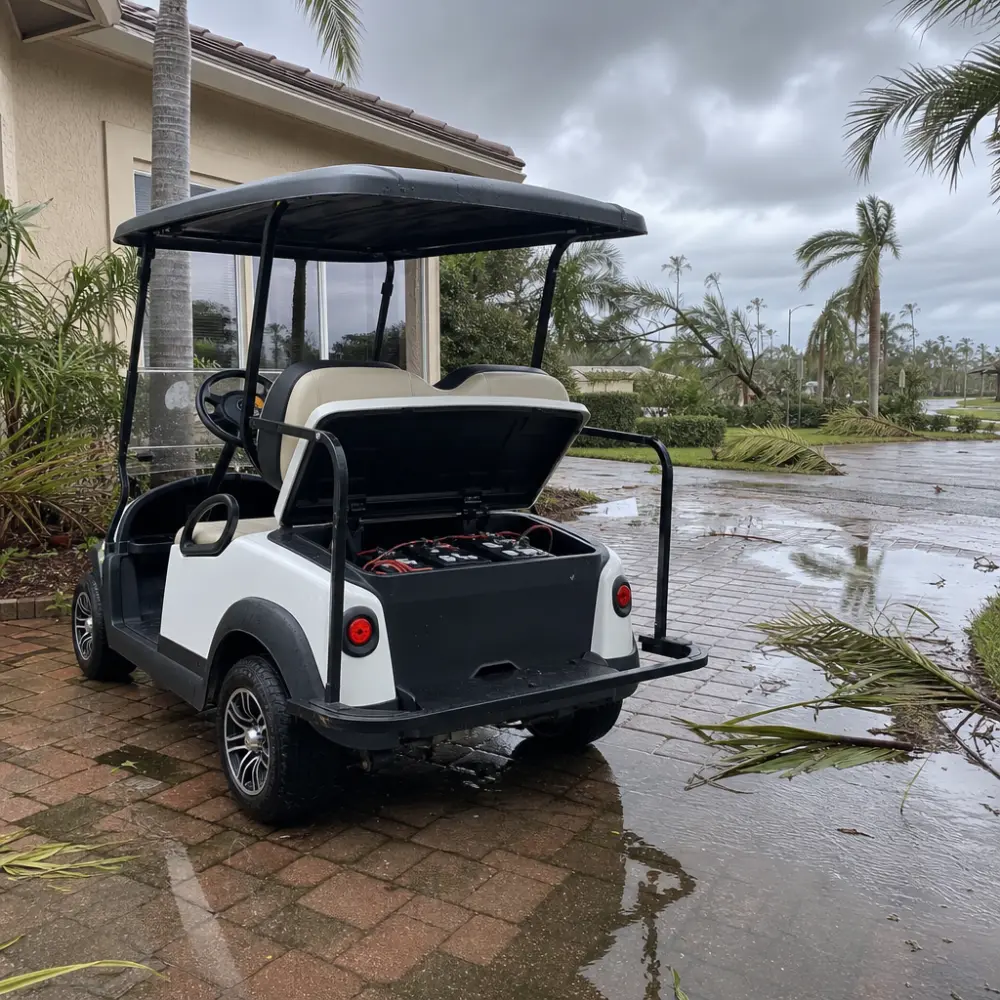
Storm surge is not a hypothetical here, it is the island’s history. Hurricane Ike made landfall on the northeast end of Galveston Island in the early hours of September 13, 2008, as a Category 2 storm with 110 mph winds, and the rising surge overtopped the island’s 17-foot seawall around 4 p.m. the day before landfall; six feet of water reached the Galveston County Courthouse downtown. Hurricane Beryl in July 2024 was a much smaller storm by comparison, a Category 1 that made landfall near Matagorda, but it still put an EF-1 tornado across Galveston Island near Jamaica Beach and caught city officials off guard with wind damage. A cart caught in either kind of event needs a specific kind of inspection before anyone charges or drives it again, which is why flooded and storm-surge carts get their own page.
Sand and sun crack tires and rubber faster than clean garage storage would. Between beach access roads, the Seawall bike-and-cart lane, and West End streets that end in sand, island carts pick up grit that works into brake drums and bearings, and UV off open water ages tires and seals faster than shaded inland streets do.
Golf cart or LSV: what’s actually legal here
Texas law starts from Transportation Code Chapter 551, Subchapter F, which never registers a golf cart as a highway vehicle but does authorize limited road use: inside a master planned community, on a public or private beach open to vehicular traffic, or in daytime on a highway posted 35 mph or less within five miles of where the cart is normally parked. On top of that framework, Galveston’s own ordinance (readopted June 2021) authorizes carts on the island’s local streets posted 35 mph or less, with no more than two lanes of traffic per direction and no state or federal highway designation. Seawall Boulevard itself is named specifically in the ordinance’s excluded-street list, since it carries a state highway designation along its whole length (State Highway 87 on one end, Farm-to-Market Road 3005 on the other), so a cart can cross it at an intersection but not drive along it. Every registered cart needs a city permit decal, color-coded by which side of 103rd Street it lives on, and east-side carts (green decal) carry more required equipment, including turn signals, a horn, brake lights, and seat belts, than west-side carts (red decal) do. Jamaica Beach and Tiki Island each run their own registration and street rules on top of the state and county framework. The whole picture, cited section by section, is on our street-legal rules page.
Where the carts live
Galveston Island itself splits into two very different cart cultures. The East End Historic District and the neighborhoods around the Strand and downtown run dense, walkable blocks where a cart genuinely substitutes for a car; the West End along FM 3005, including Pirates Beach and Jamaica Beach, is beach-community cart country where FM 3005 itself is off-limits except at designated crossings. Tiki Island, the small waterfront village just off the causeway, is dense with private docks and golf carts running short trips between houses and the water. On the mainland, Texas City, La Marque, and Hitchcock are less cart-centric day to day but sit ten to twenty minutes from the island on I-45, and we cover all three. Kemah, up the bay past Clear Lake, has its own cart-friendly waterfront streets around the Boardwalk. Bolivar Peninsula and Crystal Beach, reached by the free Galveston-Bolivar ferry, run one of the most cart-dependent beach communities on the upper coast.
How a mobile visit works
- Tell us the symptom. Will not move, clicks but no go, will not charge, sags coming back from the Seawall, squeals when braking. Most problems narrow down fast from a good description, so the tech arrives with the likely parts.
- We come to you. Driveway, garage, cart barn, or fleet lot, at a scheduled window. The $50 to $100 trip fee includes the diagnostic and gets applied to the repair.
- We diagnose before we recommend. Load test on each battery, voltage checks across the pack, charger output test, voltage-drop check along the main cables, solenoid and controller checks. We isolate the actual fault instead of selling the most expensive maybe.
- Flat quote on the spot, fix on the spot. Battery sets, solenoids, brake shoes, and tires are usually on the truck. Approve the number and most jobs are done in that same visit.
- Finish clean. Lead-acid packs get watered and terminals cleaned and coated, everything gets a torque check and a test drive, and old batteries leave with us for recycling.
Straight answers, published prices
Two things we will not do. We will not pretend to be something we are not: we are an independent service, not an authorized dealer or warranty center for Club Car, E-Z-GO, Yamaha, ICON, or Evolution. If your cart is under factory warranty, your selling dealer should handle warranty work. And we will not sell parts you do not need. A cart that will not charge gets a charger and charge-port test before anyone talks about a battery pack, and a weak cart gets a per-battery load test before we condemn six batteries when one corroded cable is the problem. If a repair does not make sense against the value of an old cart, especially one that took saltwater, we will say that too.
The work is done by experienced, insured local golf cart technicians. More on how we operate is on the about page, and the FAQ answers the questions we hear most.
Get a fast quote
A lot of owners land here after typing “golf cart repair near me” with a cart that will not leave the garage, or a rental fleet manager down two carts on a Saturday. That is exactly the call this service was built for. Tell us the brand, model year if you know it, whether it is a 36V or 48V electric or a gas cart, and what it is doing. A photo of the battery compartment or dash helps. We will come back fast with a flat number and a scheduling window, and in most cases we can reach you same-day or next-day anywhere from the Seawall to Jamaica Beach to the Bolivar ferry landing.